Service
Inground Pool Leak Detection
This service is for inground pools built with concrete, gunite or fiberglass; above-ground pools and vinyl liner pools have their own pages. Our job is to find the one place where your pool is losing water. Everything that follows (how much concrete has to be opened, what the repair costs and whether it lasts) depends on getting that right. The process is the same whether your pool is in Wilmington or elsewhere on the North Carolina coast.
What a detection visit involves
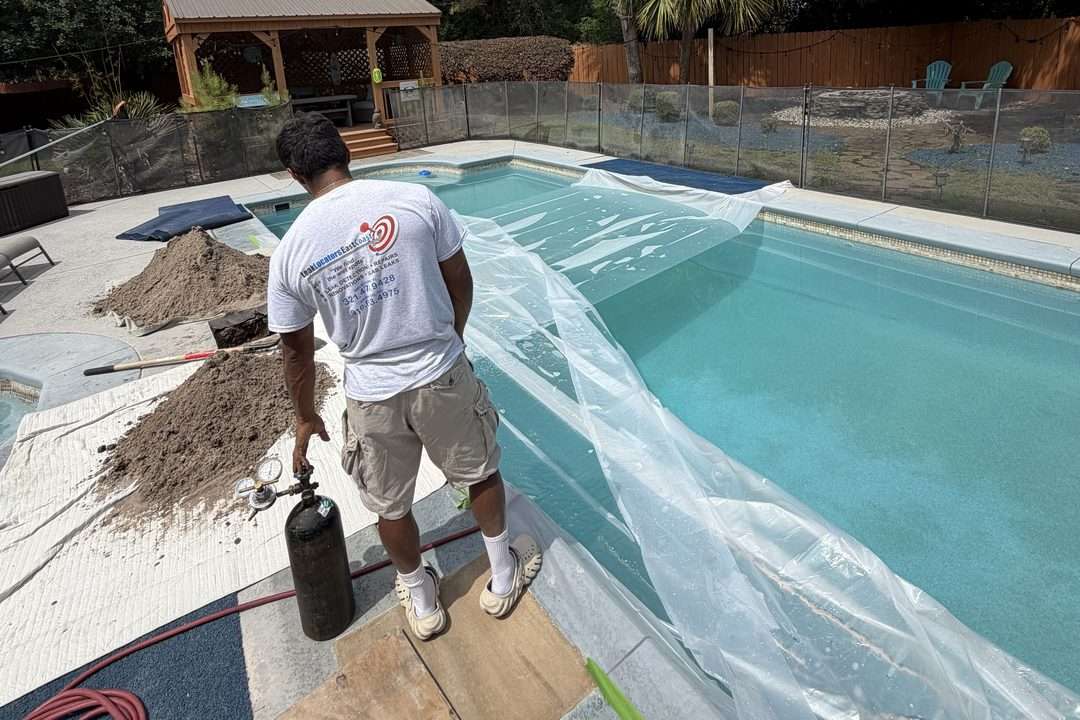
We isolate each part of the pool and test it separately instead of treating the pool as a single system. The shell, skimmer, returns, main drain and each plumbing line fail in different ways, and each sounds different when it leaks.
Acoustic listening equipment does most of the work. Water escaping a pressurized line makes a distinct sound, and once the line is isolated we can follow that sound to an exact spot rather than a general area. Pressure testing confirms which line is leaking, and dye testing confirms a suspected leak in the pool structure.
Where pools commonly leak
Which one is leaking determines what the repair involves.
- Plumbing lines
- Suction and return lines under the deck or yard. The leak is often at a joint rather than along the pipe, which is why an exact location matters.
- Skimmer
- The joint where the skimmer meets the pool wall commonly separates, and it can usually be reached without major excavation.
- Returns and fittings
- Threaded fittings can loosen and seals can fail. These are often the simplest leaks on this list to fix.
- Pool shell
- Cracks, including hairline cracks, in plaster, gunite or fiberglass. Dye testing confirms whether a visible crack is actually leaking.
- Main drain
- The main drain is harder to reach and test, which is why a leak there should be confirmed rather than assumed.
- Lights and other openings
- Any point where something passes through the pool shell can leak.
Tell us about your pool
Describe what you are seeing, and we will tell you what it may mean and what a visit would involve. If the water level is dropping fast, call us. You will reach a family-owned, owner-led team.
How do I know whether I have a leak or it is just evaporation?
If the pool consistently loses more than about a quarter of an inch a day, whether or not the equipment is running, that points to a leak. You can check in 24 hours with a bucket and a marker. Call us and we will walk you through it at no charge.
Do you have to jackhammer my deck?
Not to find the leak. Leak detection is non-invasive. Whether anything needs to be opened for the repair depends on where the leak is, and finding its exact location first is what keeps that opening small.
What if you cannot find a leak?
Sometimes the pool is not leaking, and that is a useful result in itself: we will tell you what we tested and what we ruled out. If the pool is clearly losing a lot of water and we do not find the leak on the first visit, we come back free of charge. That does not apply when the pool’s condition prevents testing, such as a dirty pool or a water level that is too low.
How long does it take?
Most residential pools take a single visit. Complex plumbing or several problems at once can take longer, and we will tell you if that is the case rather than rush the job.