Service
Pressure Testing
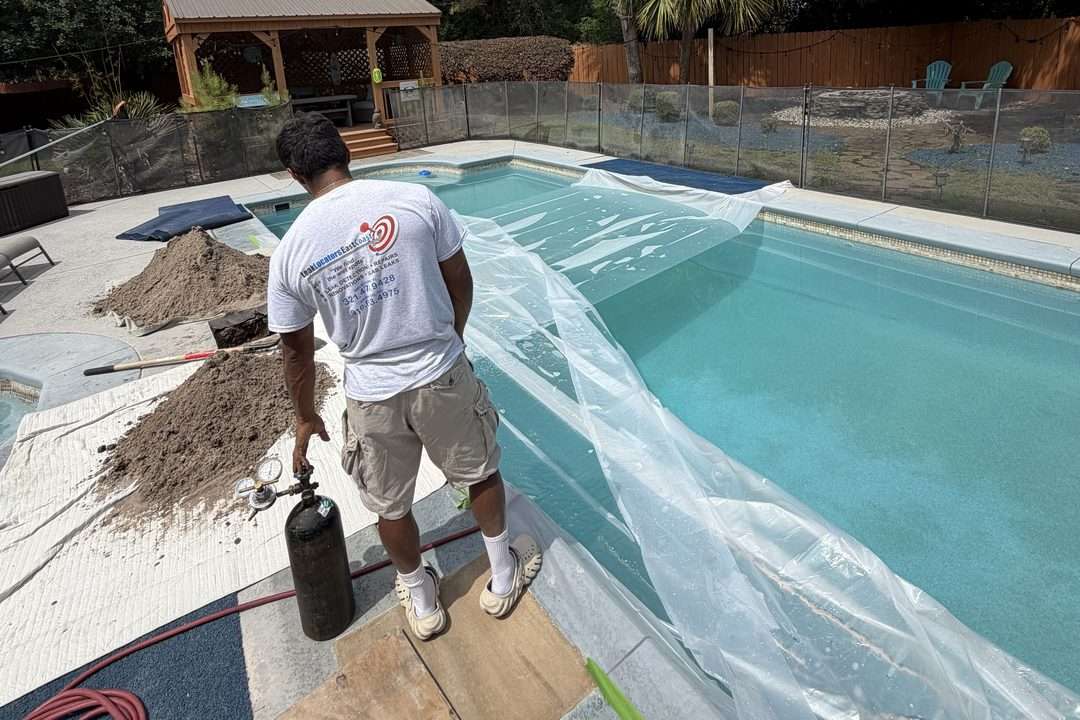
Pressure testing confirms whether a suspected line is actually leaking. Each line is isolated and pressurized while we watch a gauge, and a line that will not hold pressure is the one with the problem. It is usually one step in a leak detection visit rather than a service booked on its own, and it is not always needed: if the leak is visibly at the shell or a fitting, there is no need to test the plumbing. We use it on detection visits across our North Carolina service areas.
How a pressure test works
We plug and test the lines one at a time rather than together, because a pool losing water does not tell you which of its lines is responsible. The suction, return, main drain, skimmer and any water feature lines each get their own test.
A line that holds pressure is ruled out, which is as valuable as finding the one that does not. It keeps a repair from being attempted in the wrong place.
A failed test tells you which line is leaking, but not the exact point along it. That is the limit of the test, and it is where acoustic locating takes over: we pressurize the failing line so the leak makes a sound we can follow, then mark the spot above it. Testing narrows the search from the whole pool to one line; locating narrows that line to one spot.
What happens next depends on the results. If a line will not hold pressure, we discuss the repair with you. If every line holds, the leak is in the structure, the fittings or the equipment, and we test those instead.
What a pressure test tells you
- Which line is leaking
- Suction, return, main drain or cleaner line, each tested separately and identified by name.
- Whether the plumbing is the problem
- If every line holds, the water is being lost through the structure, a fitting or the equipment, or to evaporation. Either result changes what happens next.
- How serious the leak is
- How quickly a line loses pressure indicates the size of the leak, which helps decide whether the line needs a splice or a replacement.
- Whether a repair worked
- Running the same test after the repair confirms that it worked, rather than assuming it did.
Tell us about your pool
Describe what you are seeing, and we will tell you what it may mean and what a visit would involve. If the water level is dropping fast, call us. You will reach a family-owned, owner-led team.
Is pressure testing separate from leak detection, or part of it?
It is usually part of it. We describe it separately because sometimes it is the whole job, such as confirming a line after a repair or checking the plumbing before a renovation.
What does a pressure test actually tell you?
It tells you which line is leaking and, just as usefully, which lines are not. Each line either passes or fails. It does not map the whole pool, but it narrows several possibilities down to one.
Can pressure testing find the exact spot of the leak?
Not by itself. It identifies the leaking line. Finding the exact point along that line is a separate step that uses acoustic equipment on the pressurized line. A pressure gauge alone cannot pinpoint a leak.
Does every pool leak need a pressure test?
No. If the leak is in the shell, at a visible fitting or at the equipment pad, testing the plumbing will not tell you anything new. It is useful when the plumbing may be the source of the leak.
What happens if a line fails the test?
We locate the leak along that line, mark it, and explain what the repair involves.
Can pressure testing damage old plumbing?
We test at pressures appropriate for the plumbing. If a system is old enough to concern us, we will tell you before testing, not after.